- Ground slopes away from the house. At least 6 in of fall over the first 10 ft where the lot allows.
- Topsoil or sod cap. A few inches on top, so the lawn grows back over the trench.
- Filter fabric wrap. Lines the trench and folds over the top, so clay can't clog the gravel.
- Washed gravel. Clean, roughly 3/4 in stone. Water moves through it easily.
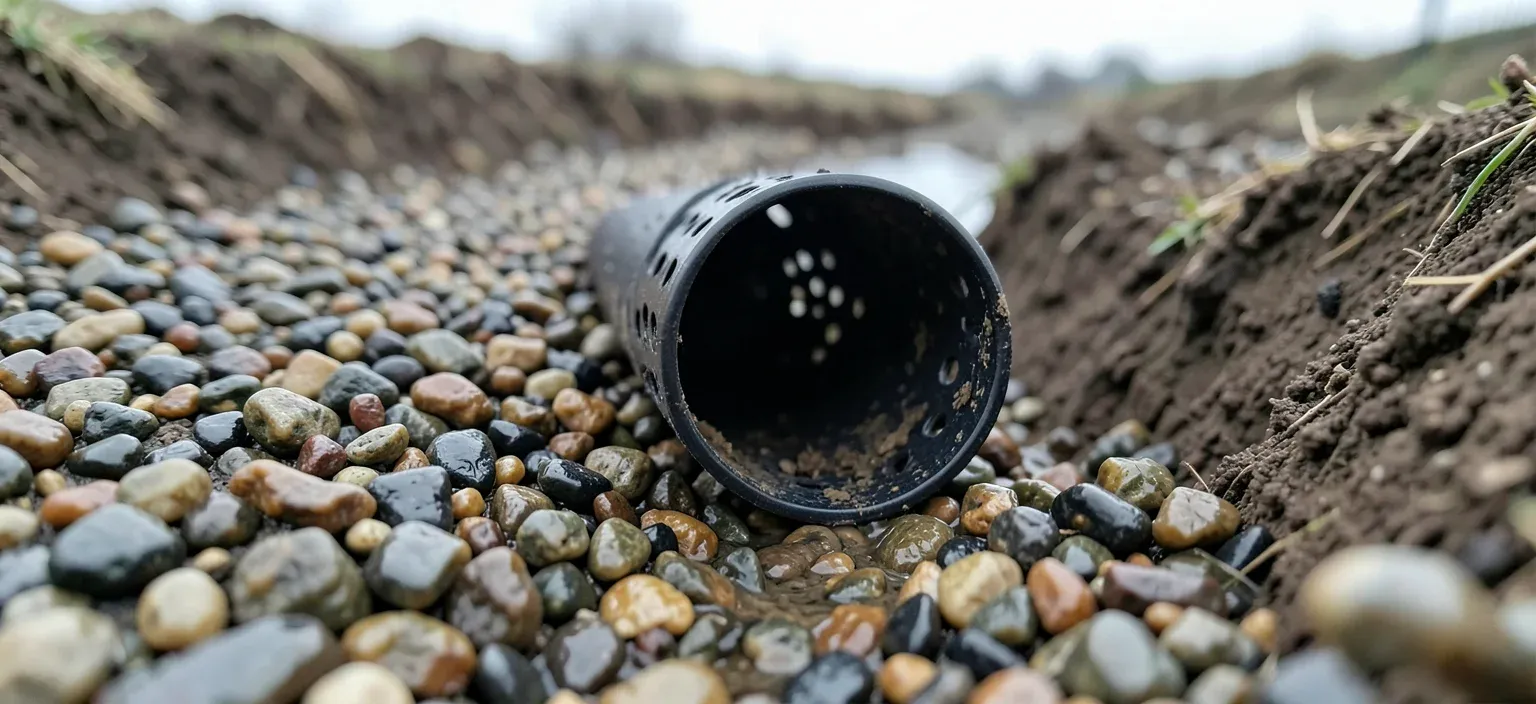
- 4 in perforated pipe, holes facing down. Water rises into the holes from below and the pipe carries it away.
- Gravel bed under the pipe. A couple of inches, so the pipe sits even and doesn't sag.
- Clay soil. Water barely soaks in, so it moves sideways toward the gravel.
- Catch basin (optional). A grated box at a low spot that feeds surface water into the line.
- Cleanout. A capped pipe at the start of the run, for flushing the drain later.
- Steady downhill slope. About 1% (1 in of drop every 8 ft) at minimum, with no flat spots.
- Solid pipe to the outlet. No holes, so collected water isn't lost back into the soil.
- Outlet. A pop-up emitter lower in the yard, a curb outlet (city permit), or a sump pump.
Get a free French drain estimate →
Do French drains work in clay soil?
Yes, but only if the drain is designed to carry water, not soak it into the ground. Sandy soil absorbs water along the trench. Clay barely absorbs anything, so in Sunnyvale the pipe has to deliver the water to an outlet: a curb outlet, a daylight point lower on the lot, or another approved system. Why clay holds water →
Three details matter more in clay:
- Filter fabric. Fine clay particles clog gravel and pipe. Wrapping the gravel in landscape fabric keeps the drain working for years.
- Steady slope. About 1% (1 inch of drop per 8 feet) keeps water moving. Flat spots collect silt.
- A real outlet. Plan where the water ends up before digging. A drain with nowhere to go just moves the puddle.
How deep should a French drain be in clay soil?
It depends on the job:
- Surface water in a lawn: often about 12 to 18 inches deep.
- Water against a foundation or a wet crawl space: usually deeper, sometimes 2 to 4 feet, to catch water before it reaches the house.
- Behind a retaining wall: at the base of the wall.
Deeper trenches cost more, so a contractor should explain why a depth was chosen. See French drain costs →
Where should a French drain empty?
Water has to end up somewhere legal and lower than where it started. Common outlets:
- The street gutter, through a curb outlet. Work at the curb is in the public right-of-way, and in Sunnyvale that kind of work goes through a Public Works encroachment permit.
- A daylight outlet at a lower point on your own property, if the lot slopes enough.
- A sump basin and pump, when there’s no downhill outlet.
Water should never be sent onto a neighbor’s property.
Do I need a French drain around my house?
Not always. Try the cheap fixes first:
- Clean gutters and make sure downspouts aren’t dumping water at the foundation.
- Add downspout extensions so roof water lands several feet from the house.
- Check that the ground slopes away from the house.
If water still collects after those, or the problem is groundwater rather than roof water, a French drain is the next step. Water against the foundation →
French drain vs dry well, channel drain and catch basin
| Option | What it does | Good in clay? |
|---|---|---|
| French drain | Collects water underground along a trench and pipes it away | Yes, with fabric and a real outlet |
| Dry well | Underground pit that lets water soak in | Often not. Clay absorbs slowly, so test percolation first |
| Channel (trench) drain | Grated surface channel across a driveway or patio | Yes, for hard surfaces |
| Catch basin | Box with a grate at a low spot, piped away | Yes, for one low spot that collects surface water |
| Swale | Shallow, gentle ditch that guides surface water | Yes, if the lot has room and slope |
| Sump pump | Pumps collected water up and out | Yes, when there’s no downhill outlet |
Many good systems combine two: catch basins at low spots tied into a French drain line, for example.
Do I need a permit for a French drain in Sunnyvale?
Work at the curb or sidewalk needs a Public Works encroachment permit, which requires a licensed contractor. For drainage work fully on your own property, check with the City of Sunnyvale Building Division before work starts. A licensed contractor should know the current rules and handle any permit.
Always call 811 before digging. It’s free, and it marks buried gas, electric and water lines. Check any contractor’s license at cslb.ca.gov.
Common questions
How long does a French drain last?
A well-built drain with filter fabric can last decades. Drains without fabric clog faster in clay.
Can I install a French drain myself?
Some homeowners do short runs. In clay, digging is heavy work, and the outlet and slope are where DIY drains usually fail. Curb outlets need a licensed contractor and a permit.
What’s the difference between a French drain and a curtain drain?
A curtain drain is a shallow French drain placed uphill of an area to intercept water before it gets there. Same build, different location.
Get a free estimate from a licensed French drain contractor →
Sunnyvale Drainage Help is a free referral service, not a contractor. Contractors pay us for referrals. How it works · Updated 2026-10-26